
Jaia Hamid Bashir spoke with Hobart editor, Breen Nolan, about her debut poetry collection, The Afterlife of Sweetness, how she sees the self as a kind of fiction and her love of making memes.
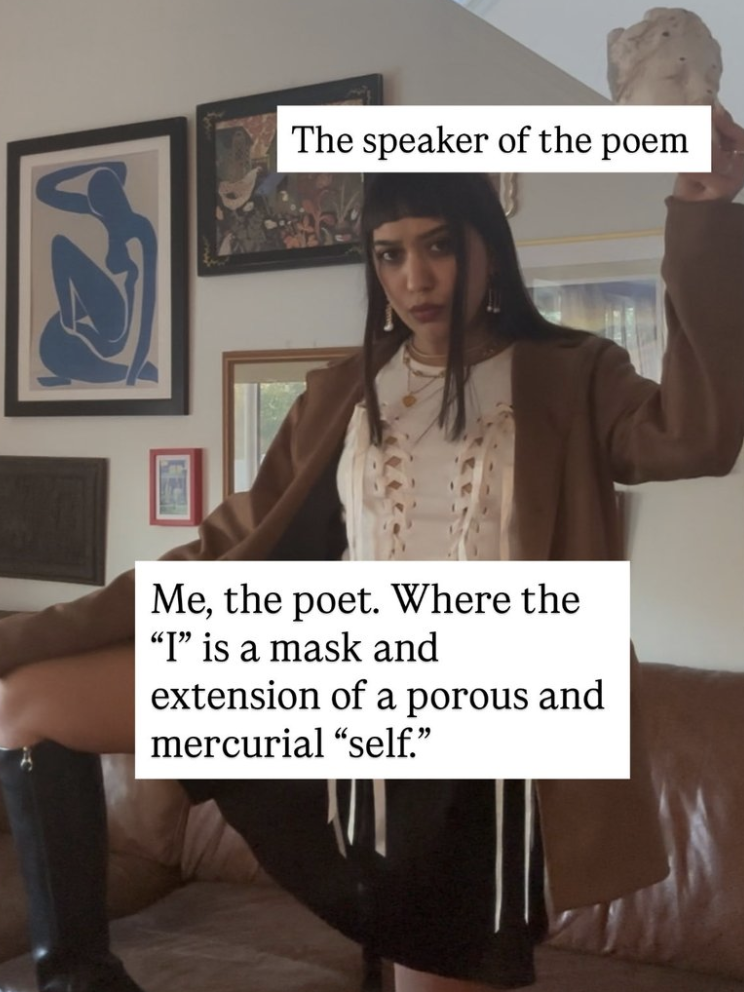
I came across your Twitter profile during a late-night scroll. So, I have to thank the algorithm (btw, I’ve never thanked the algorithm before), because without it, I would have never seen the brilliant poetry meme you posted last October or discovered your poetry! So, I guess the internet isn't all bad. Have you had any surprising/good things happen to you as a poet (or a person) because of the internet and/or social media?
I hate to admit it, but for all its failings and for all the ways it is marching us toward the end of humanity as we once knew it, I love the Internet. I am a creature of it. I grew up online. I think I’ve been online every day for nearly two and a half decades. I am a bona fide millennial of the Tumblr era. I had entire limerences and obsessions with people I met on Tumblr. The Internet is where I’ve lived most of my life. I know no one wants to admit this. I’ll admit it.
Online, I get granted a kind of jester’s privilege: creating stupid little memes, tweeting random-access interpretations, posting outfits, and being a little ridiculous in public. I don’t think who I am is a 1:1 with my Internet persona, and there is freedom in having that barrier.
I love making memes. To me, the process feels close to writing poems: the weaving together of image, symbol, and timing, the compression of meaning within a small spatio-temporal frame.
I went to my MFA with the optimism of finding my people. That isn’t what happened. In part, because I went to Columbia, where imposter syndrome and the general malaise of being an artist in a city so saturated with ambition can be overwhelming. You feel like you’re constantly going barefoot through brambles; everything makes you tender. You are running, always. Your feet get callused, and in Chinese medicine, your feet are your second heart.
I run a small ongoing poetry workshop called Visions, and many of those poets have become my people. Zach, Maddie, Hanna, Caleb, Kunal, Kierstie, Julia, etc. I met and deepened all of these friendships because I was chronically in the corner at the party that was once Poetry Twitter.
The party is over now. I miss it.
I was thrilled to see your debut poetry book The Afterlife of Sweetness was selected as the Winner of the Wheeler Prize in Poetry in The Journal, the literary magazine at Ohio State University’s MFA Program in Creative Writing. That’s so exciting! What was it like to receive the news that you were the winner?
I was driving to Provo, an incredibly conservative, cloistered bubble, one of the seats of Mormon America, where there are maybe fewer than five coffee shops in the entire city, because drinking hor drinks is forbidden in doctrine, when I got the call. For money, I coordinate weddings and work in event planning, so every phone call feels important for a very practical reason: it might be work.
I was told by the prize judge, Marcus Jackson, that I had won. It was shocking and surreal. I had only just finished the manuscript and submitted it to three places; I was a finalist or semifinalist in the other two. It felt like a sunburst went off behind my skull. I am already an awful driver and had to just keep it together long enough to park my car and get coffee. The first person I called was my husband. After that, I had to sit with it, and with the accumulating fear.
As a poet, you’re often told you only get one real shot: your debut. That book is the rocket, and how far it gets into the stratosphere is supposed to determine the trajectory of everything that follows. I think I cried most of the next day.
You're not new to winning prizes, as your chapbook, Desire/Halves, won the inaugural chapbook contest at Nine Syllables Press. Congratulations on that as well! What were some of the differences you found in putting together Desire/Halves versus The Afterlife of Sweetness?
Thanks! And thanks for all the kind comments here! Seriously! THANK YOU.
Afterlife of Sweetness came together because, between 2018 and 2024, I wrote over four hundred completed poems. [Sylvia] Plath had the self-discipline to finish every poem she ever started. I am no Plath, but I’ve chosen to keep this private edict going in my own methodology.
Most of the poems I write don’t go where I want them to. They feel like there isn’t a heartbeat, no engine. Just unanimated. The nothing organs that are extracted from the body are disintegrated in the hospital furnace. Desire/Halves was the first trial run of these concepts.
After I published Desire/ Halves, I was incredibly depressed. I don’t think I’ve ever been more depressed in my life than when I was wandering around Smith College for four days and touring Emily Dickinson’s house and looking through the Plath archive. I had to take a month where I tucked poetry to bed and turned off the lights. It is what finally convinced me to get on depression medication, actually. Thanks, Emily and Sylvia. Wish I could share my medications with you.
The name of the collection, “The Afterlife of Sweetness,” appeared in my mind’s eye, like a floating mote in my eyeball, while I was walking around the Al-Ahmbra Palace in Granada. It was golden hour, on my honeymoon, sort of, and I was thinking about how throughout human history, a few people, the small minority, of people get to a life that is some people’s idea of heaven or paradise.
I don't think anyone has asked me about this, but basically, the title is "What Remains After Something Good is Gone."
I really do think I'm haunted. Even when I'm really happy, I think about how this is a very fleeting sensation. Soon I'll cry.
Like many, I’ve been keeping an internal philosophical log on the relationship between tech billionaires and life extension. Bryan Johnson’s childhood home is a few minutes away from my current house. If one has achieved everything materially possible, what would make an idea of an afterlife seductive? Why not live in this body on this planet eternally? What does heaven even mean at that point?
While I was rewriting poems in Desire/Halves and working on new ones for The Afterlife of Sweetness, I stopped wanting to sound smart and gave myself over to the power of the image and concept. Plus, I finally got rid of the real post-MFA mind killer, "What do x and y in the workshop think?" Who cares.
How does it feel to have your second published book out in the world?
Having a book out in the world is a fucked up and peculiar experience. I’m deeply grateful for it, but the “outness” is also a kind of inwardness. The book isn’t sitting at your local Barnes & Noble. It’s not a large release. I’m not publishing with a major press. Ohio State University Press puts out one poetry collection a year, and I’m fortunate to have been chosen from the slush pile and given that visibility.
At the same time, it’s difficult to exist as this kind of artist. Poetry, at least in this country, is often treated as unmarketable, esoteric, pretentious. And “pretentious” becomes a kind of warning label, something almost venomous, as if you have to avoid it at all costs. That pressure shapes how the work is received and how the artist is allowed to exist.
So there’s a strange tension: the book is here, but I still feel like I’m circling it. It’s as if the table has been set, but I haven’t yet been fed.
What has changed is my sense of what’s possible. Having the book out has expanded that. It’s made me want more, not in a way that diminishes gratitude, but in a way that refuses self-satisfaction. I want to do more work. I want to push further. I’m wary of anyone who feels completely satisfied. That kind of stillness is dangerous for an artist. In short, I can't wait for the next book.
I read in an online interview you said, "Being raised by immigrant artists, writing became a method of excavation from an early point in my life. For me, poetry is a choreography where you dance with what is real, where the real is flexible and mutable." Can you speak more about how you work within that choreography to write poetry?
I don’t find conversations about the taxonomy of genre particularly interesting. In fact, I find them mostly tedious. What does concern me, though, is the tendency to position poetry as more aligned with nonfiction than with fiction.
I’m not interested in reality as a stable category. We’re all moving through mismatched versions of what we call the real. Even the existence of terms like “magical thinking” reveals an anxiety about anything that resists a fixed ontology—especially one that serves capitalism, where there is no room for ritual, no space for the sacred beyond commodity fetishism.
So I hesitate to treat reality as objective or stable. Within that framework, the speaker of my poems is not identical to me. And yet, I am always writing from within a body. There is no language I can produce that doesn’t carry some trace of me, some molecular residue of my experience or being-ness.
As the child of immigrants, that instability becomes even more pronounced. The homeland is already a kind of mythology. The Pakistan my parents knew in the 1970s and ’80s is not recoverable. What I inherit is not a place, but a set of stories, projections, and absences. Identity, then, especially as it relates to otherness or displacement, is constructed through fiction as much as through history.
So I’ve come to think of the self as a kind of fiction as well. And most performances, at their core, are driven by a desire to be seen, to be loved, to be accepted.
When did you begin writing poetry, and how has your practice evolved? Secondly, do you have any favorite pieces of advice you’ve received from teachers or mentors?
The first poem I ever published was in second grade. It was a poem about a ballerina at the end of her life, watching leaves fall off a tree, and in that twirling, thinking of her own decaying body and the stage. These aren't new preoccupations. My mother received a phone call. I was born with a certain morbidity and obsession with death. My mother had two stillborn children before me. I think I’ve always been haunted.
My teacher, Ms. Morgan, then had me write a poem in class, by hand, on paper. She then submitted my poems to a contest, and I won some kind of school-wide prize. Sometimes I wonder whether I possessed some innate talent or whether it was because I received this affirmation early in life. But I was always destined to be a reader.
I was an antisocial, immune-delicate child. Go to Wikipedia. Look up any writer’s biography. Most had a period of being bedridden. There is something about having to press pause when you are at your most feral and uninhibited, when you have to think about embodiment because you are weak and ill, that almost serves as a precursor to being obsessed with symbols, namely, language.
All the best advice is something colored in between the lines of rewrite, rewrite, and keep going.
One of the professors in my early writing career whom I am most grateful to is Katherine — Kate Coles. I was taught by her very early in my writing trajectory that poetry is not therapy, poetry is not decorative, poetry is a serious and intellectual challenge, and a field of thinking. She graded our poems. She told me I might have to wallpaper my bathroom with rejections. She prepared me for the reality of living as an artist, which is actually more similar to that of scientists before our contemporary iteration of science was regulated, performed within institutions, and tracked by profit margins. I love her so much.
In my MFA, Major Jackson, whom I adore, basically asked me, "Why are you writing all these poems about horses?" I then didn’t have a great response. I then wrote “In Dead Horse Point We are Alone,” because, apparently, I was having a horse girl phase in my MFA. That was the poem that germinated into this book. He kind of gave me the go-ahead. Same with my brilliant thesis advisor, Shane McCrae. I've been lucky to have great mentors.
I love how The Afterlife of Sweetness is composed in three sections. I. Sacred Rot, II. Brine, and III. FANNA or UNPARADISE?, and I’m curious how you placed the poems in each corresponding section. Did you know going into the collection you would do that? Or was it discovered during the editing process?
I frequently discover the most during the editing process. When I teach—whether through personal mentorship, virtual workshops, or as a poet-in-residence—I emphasize that writing is, in many ways, editing. I love that flow state you can enter while drafting, but I see it as an adrenaline engine, one that isn’t always reliable for producing great work. The real work, the lasting work, comes from the pressure of editing and re-editing.
The three sections emerged from an engagement with fermentation and decay, the ways body, corpse, spirit, and the eternal begin to collide and collapse into one another. I was thinking about rot as decomposition, but also about brining as its counterpoint: a way to arrest decay, to preserve, even to savor.
The poems in Brine are largely rooted in the American West. I’m from the Great Salt Lake, so that heavy salt presence becomes both literal and symbolic. It holds the tension between preservation and transformation.
The final section draws on fanna or an “unparadise,” from Sufi thought, a concept akin to moksha or nirvana in other Indo-religious traditions. It points toward the annihilation of the ego as a path to transcendence. For me, the progression became clear: rot or preserve, and then, ultimately, release. A movement toward dematerialization, toward disembodiment as the spirit’s highest desire.
I wanted the sections to follow that internal logic. The decision to structure the book in three parts also felt inevitable threes recur throughout the poems. While there is strong Islamic imagery, there is also overt Christian symbolism. The vision of an afterlife shaped by sweetness draws from a kind of religious syncretism, and that, too, informed how I mapped the book.
I started thinking about the poems as a mixtape—how one fades into the next, how transitions create continuity. What matters is the connective tissue, the sense of flow. The poems need to build a world, and that world has its own internal logic. That’s where the structure comes from.
Animal imagery, and imagery of hunger, rot, and decay are present throughout these poems. I'm thinking specifically of "The Mouths," where you write, "Everything is / a sign if you look closely. I wrinkle as I age - the fauna / inside ferments. I craft wine. I scrape the gleaming armor / of salmon and lay it on stone to dry. I've borne these / scales and created more fish.” Do you find that you’re seeking imagery in your poems? Or does the imagery appear for you?
I have synesthesia.
It wasn’t until my twenties that I realized I experience the sensorium differently from most people. I had assumed it was normal to have such intense reactions to sensory stimuli.
I’ve always been drawn to ASMR, before I even knew what to call it. I couldn’t sleep without an ASMR video on for years, and I’ve long associated color and texture with sound. I’m a huge jazz listener; I’ve probably spent over a thousand hours with Miles Davis alone. Part of what draws me to jazz, as well as ambient and electronic music, is that I feel sound and the music of language in a way that isn’t typical.
But poetry works differently for me. When I begin a poem, it doesn’t start with language. It starts with an image. The concept arrives visually, almost fully formed, and only afterward do I begin describing it. For me, the image precedes language.
I’m fascinated by writers who say they hear the words first. That rarely happens to me. My process is the opposite: writing becomes an act of translation. I’m trying to find language for an experience that is first neurological, then phenomenological, and perhaps even metaphysical, something I perceive and then have to realize through words. This particular poem started with my wanting to write one about Carmy from The Bear, played by Jeremy Allen White, with whom I share a birthday (Aquarius twin). However, then I had this image of a wreath made out of garlic. It grew from that place (like a green onion).
I wrote one of the poems in The Afterlife of Sweetness after leaving my best friend's then girlfriend’s pool party. It was a sweltering June day, a Gemini birthday, everyone beautiful, the light thick and golden. But I had to leave. I had to attend to writing. There are people in my life who get it, and others who don't.
Poetry, for me, comes from the image; it is fleeting, and I have to get it onto the page. There will be other pool parties. I wouldn’t have written many of the poems about eyeballs in the book if I had stayed at that party. Plus, I mostly feel ambivalent about everyone who was there. The poem remains.
Do you have any tricks up your sleeve that you use if/when you're struggling to get anything on the page?
I don’t think I’ve ever experienced writer’s block. What I feel instead is depletion. The ideas are always there, images, fragments of language, whimpering to be let in. When I finally open the door, I can see the claw marks. However, I do get severely depressed, and I do sometimes have to shut down. I feel like I lose a lot of ideas each time I do this. But sometimes, that is what you have to pour out to replenish your cup, you know? Recently, a friend of mine told me a story about a poet, who I will not name here, who was just fed up with the very typical Q & A question surrounding “how do I build a writing process,” and “how do I find time to write,” and basically what I heard from my friend’s account is this poet said, “I don’t give a fuck about anything else, except for poetry.” I think when you love something passionately, there is an urgency. People do all kinds of batshit crazy things for romantic love. I think the same thing is true for people who truly love literature. You just keep going on your hands and knees, you run up those stairs like an animal. So, I try to give fewer Fs.
Can you talk about what you're working on now?
Yes! My second collection, tentatively titled Outer Darkness, is the first time I’ve been fleshing out what it was like to grow up non-LDS around the LDS Church. Each poem is also a place poem: the laundromat, the Chinese restaurant, the dive bar. There are also sequences based on the grid layout of Salt Lake City, with the temple at its center. This work is about how cities are zoned, about migration at both the social and ecological levels, and, again, about God. I think all my work will be about God in some way.
I was talking with my husband today about writing an academic paper that explores Mikhail Bakhtin’s concept of the chronotope and its potential application to contemporary poetry. Maybe I'll go completely insane and head back to academia and live in that cave.
I want to start painting again and have my first solo show in ten years. Maybe twenty.
I’m also working on two novels. The one I can speak about is a novel-in-stories, a polyphonic narrative told from multiple points of view, centered on a fictional family, the Firdausis. The name gestures toward the Persian poet Ferdowsi, author of the Shahnameh, a work that can, in some ways, be read alongside epics like The Odyssey. The book moves across time and geography: a love triangle at a prestigious school in 1980s Lahore; brown fuckboys drifting through Paris; a Pakistani self-styled Joni Mitchell; a faux nonfiction essay on the late Jeff Buckley and his fascination with the Pakistani legend, Nusrat Fateh Ali Khan.
Maybe it is cliché, but it feels like every poet is now joining the poet-to-fiction pipeline. Maybe it is because most of us crave more readership and money. I just know I like writing dialogue. I want to keep learning, failing, and growing.


